
You’ve got good people, so why does the team keep wobbling every time something changes? A new hire joins, a key person leaves, the strategy shifts—and suddenly communication gets messy, conflicts surface, and results slip. The team is not broken; it is following a pattern that shows up again and again. Groups start cautiously, hit friction, find their rhythm, deliver strongly, and then eventually end or reset.
Bruce Tuckman’s five stages – Forming, Storming, Norming, Performing, and Adjourning – and Patrick Lencioni’s five dysfunctions around Trust, Conflict, Commitment, Accountability, and Results give simple names to those patterns so teams can see what is happening and respond faster. This article will not walk through every part of the Tuckman model again. You can use the links at the end if you want more background. Here, the goal is to show how to use those stages to build and keep high-performing teams.
The Stages at a Glance
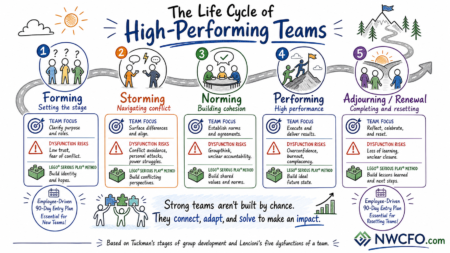
For this article, the stages are used in a very simple way:
- Forming – people are polite and are figuring out why they are here and who does what.
- Storming – real differences and friction show up.
- Norming – the team starts to agree on how to work.
- Performing – the team can focus most of its energy on results.
- Adjourning / Renewal – work ends, or the team resets after a change.
Where Teams Get Stuck—and What to Do Next
Teams often move awkwardly from forming to performing. At each stage, certain trouble spots are more likely to appear: artificial harmony during the Forming stage, destructive or avoided conflict during the Storming stage, weak commitment during the Norming stage, drift from results during the Performing stage, and clinging to the old team during the Adjourning/ Renewal stage. The table below summarizes the focus of each stage, the key dysfunction risks, and practical ways to use the LEGO® SERIOUS PLAY® method—a hands on facilitation approach that uses models and stories to unlock “hard fun” learning– and an Employee-Driven 90-Day Entry Plan to keep the team moving.
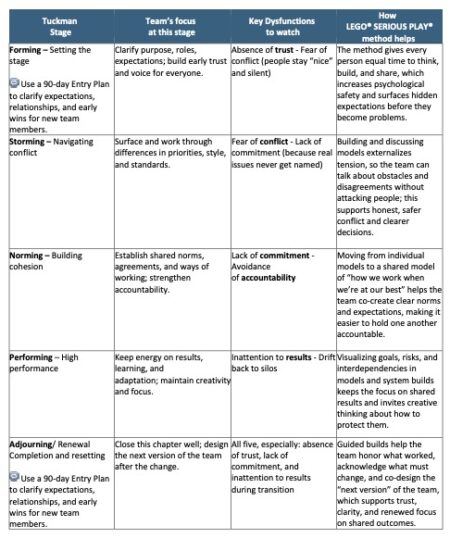
After reviewing the table, two patterns matter most in practice:
- Whenever membership or strategy changes, teams briefly return to forming and storming; and
- Tools like the Employee-Driven 90-Day Entry Plan and the LEGO® SERIOUS PLAY® method help them move through those moments faster instead of getting stuck.
Moving Through the Stages on Purpose
Teams do not move from forming to performing by accident. They move when people change how they work together, especially at four moments: getting started, working through conflict, turning agreements into results, and resetting after change. At each of these points, the 90-day entry plan and the LEGO® SERIOUS PLAY® method give teams structure and language to talk honestly, align on what matters, and commit to a small number of concrete changes.
- Forming to storming — clarify purpose, roles, expectations, and invite real questions.
- Storming to norming – name tensions, agree on a few explicit norms.
- Norming to performing — make ownership and shared metrics visible.
- Performing to Adjourning/Renewal — close the chapter, design the next one.
Integrating Newcomers Without Losing Performance
When someone joins or leaves, the team is briefly back in forming and storming. The question is whether someone handles that cycle intentionally or leaves it to chance. The Employee-Driven 90-Day Entry Plan provides both the team and the newcomer a clear roadmap: what success looks like, who they need to know, and how feedback will work in the first three months.
In practice, that looks like a simple rhythm: a thoughtful welcome and peer sponsor on day one; story-based introductions, a quick norms reset, and a few planned stakeholder meetings in the first month; and brief 30‑, 60‑, and 90 -day check-ins focused on what is working, what is confusing, and what the team will adjust together.
These moves keep performance from sagging every time membership changes and make it clear that integration is a shared responsibility, not just an HR checklist.
Why This Approach Is Personal At NWCFO
High-performing teams do not avoid the Tuckman stages, or the dysfunctions Lencioni describes; they learn to spot them sooner and respond more deliberately. By pairing a shared language for where the team is on the ladder with practical tools—like the Employee‑Driven 90‑Day Entry Plan and the LEGO® SERIOUS PLAY® facilitation method—teams can move through each cycle faster, protect trust, and keep their best energy focused on the work that matters most. NWCFO was built around being part of that journey, providing supervisor and leadership development and outsourced CFO, controller, and HR leadership without the fixed overhead of full‑time roles. The emphasis is on honest advice, ethical practice, and practical tools that fit how real teams work—not on buzzwords or one-size-fits-all programs.
By Mary Ellen Normen, Empowerment Growth Strategist | Learning Experience Designer
Further Reading:
Lencioni, P. (2002). The Five Dysfunctions of a Team: A Leadership Fable. Jossey‑Bass.
Normen, M. E. (2026, January). “Hard Fun”: Transforming teams and processes through 100‑100 conversation. School Business Now | E & S Development Group
Tuckman, B. W. (1965). Developmental Sequence in Small Groups. Psychological Bulletin, 63(6), 384–399. https://doi.org/10.1037/h0022100
Tuckman, B. W., & Jensen, M. A. C. (1977). Stages of Small‑Group Development Revisited. Group & Organization Studies, 2(4), 419–427. https://doi.org/10.1177/105960117700200404