
You’ve said it clearly. Your team nodded. Everyone seemed aligned. So why did the project not deliver what you expected?
If that sounds familiar, you’re not alone. Many communication breakdowns are not caused by laziness, low capability, or lack of commitment. They happen because leaders assume clarity when they have not actually created it.
“The single biggest problem in communication is the illusion that it has taken place.” — George Bernard Shaw
Let’s talk about:
- Why expectations and assumptions get confused in day-to-day leadership
- The hidden business cost of unclear communication
- Six practical shifts that improve team clarity
- A simple framework to use in conversations right away
The moment it became obvious for me
Tight deadline. The leadership team needed a financial analysis for an urgent board meeting. That week.
The project was not unusually difficult, but it did have a lot of moving parts. Several people were involved. The steps mattered. The sequence mattered. The details mattered.
A meeting was called. The project was explained. The deliverables were outlined. The work was assigned.
Walking out of that meeting, it felt like everything was aligned.
Clear direction. Strong momentum. Everyone knew what to do next.
We were going to get this done on time. Or at least… that is what I thought.
Two days later, the work started coming back. Different interpretations. Different priorities. Different outcomes. Not the result that was needed.
My first reaction was frustration. Why does this keep happening? It seemed obvious what needed to be done. It had been discussed. The team had heard it.
But after the frustration settled, a harder question came forward:
Why does this keep happening? I needed to look in the mirror and ask myself – was I clearly communicating the expectations? Or was I assuming that others understood? Were all the words floating around in my head actually being voiced to my team? I found that I give a lot of directions without asking questions. Questions that allow clarity. Questions that come from curiosity which leads to better communication. I had to find those questions. For me and for my team to be able to achieve success.
Where communication breaks down
Leaders communicate all day long. Emails. Meetings. Slack messages. Hallway conversations. Quick updates between competing priorities. And somewhere along the way, many leaders start believing this:
If it was said, it was understood. But communication does not work that way.
Communication is not about what is said. It is about what the other person hears, interprets, and acts on. That interpretation is influenced by experience, workload, stress, context, and assumptions that may never be voiced.
Three breakdowns show up again and again in fast-moving organizations:
- Thinking the message was clear
- An idea feels complete in the leader’s mind, so it gets expressed as if everyone else can see the full picture too.
- But what feels obvious internally is often communicated with partial or vague information, leaving the message open to interpretation.
- Thinking the message was understood
- Someone hears the instruction, fills in the blanks, and moves ahead with confidence.
- Only later does it become clear that the blanks were filled in incorrectly.
- Knowing there is confusion—but not slowing down
- Sometimes people know the message was unclear. They just do not ask.
- Maybe they do not want to appear uninformed. Maybe they think they should already know. Maybe everyone is moving too fast to pause.
All the above is when assumptions take over.
The Business Cost
Assumptions do not just create mild misunderstandings.
They create:
- Rework
- Frustration
- Missed expectations
- Broken trust
- Delays
- Unnecessary stress
And in small to midsize businesses, those costs add up fast. When teams are lean, people take on multiple roles and decisions are made quickly. That means even one unclear conversation can ripple into missed deadlines, wasted effort, and leadership tension.
The uncomfortable truth is this: When expectations are not clear, leadership is part of the problem.
That does not mean the leader failed on purpose. It means speaking was mistaken for communicating. Intent was treated as if it were enough. Implied expectations were treated as if they were shared expectations. But asking people to work from unspoken assumptions is like asking them to navigate without a map.
That is not a performance issue first. It is a clarity issue first.
Six Shifts That Improve Clarity
- From “I said it” to “Did it land?”
Instead of assuming the message was clear, ask for reflection at the end of the conversation.
– How would you summarize the plan?
– What do you see as the next step?
– What does success look like to you?
Those questions reveal whether alignment is real or imagined. - From “They should know” to “Let me define it”
Clear expectations include more than the task itself.
Define:
– What success looks like
– What “done” means
– Timing and priorities
– Decision-making boundaries
– Resources needed
– Who should be involved
– When progress will be reviewed
If those points are missing, the communication is not finished. Look at this list before you communicate and identify how you will address each item. - From “I understand” to “Let me reflect back”
– When someone else is giving direction, reflect it back.
– A simple phrase works well: Here is what I am hearing. Did I get that right?
– It slows the conversation down in the moment, but it usually saves significant time later. - Investing time to save time
– Rushed communication can feel efficient. It rarely is.
– Unclear communication simply pushes confusion downstream.
– Going slower at the beginning is often the fastest way to get to the right result. - Invite questions—and mean it
– “Any questions?” often ends a conversation. Instead, find questions that truly reflect curiosity.
– These questions open one up:
What questions do you have?
What feels unclear?
What additional details do we need before moving forward?
What are the next three steps we will take?
– That small shift changes the tone from compliance to collaboration. - Use the 3-Level Clarity Check
– A simple framework can help leaders close conversations with alignment.
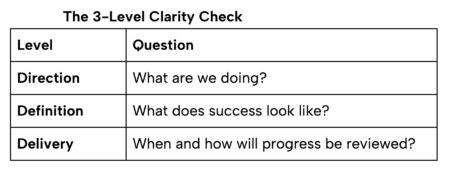
If those three answers are not clear, the conversation is probably not finished.
What Leaders Can Ask Themselves
Most communication breakdowns do not come from a lack of effort. They come from the illusion of clarity.
That makes these reflection questions useful:
- What is being assumed right now?
- What has not actually been said out loud?
- Where does the conversation need to slow down to create clarity?
Leadership is not just about setting direction. It is about making sure the direction is actually understood.
For you –
- Where might assumptions be replacing clear expectations?
- When did a recent miscommunication create unnecessary work?
- What conversation could be revisited this week with more clarity?
- Which of the six shifts would make the biggest difference right now?
Because expectations do not create chaos.
Unspoken expectations do.
What questions are you going to add to your communications?
By Julie Shiflett, Founding Partner / Multi-faceted Finance Aficionado / Personalysis Guru and Coach